Protect what needs to be protected.
Embedded intelligence serving critical civil infrastructure. From satellite constellations to offshore wind farms, from shipping lanes to power grids.
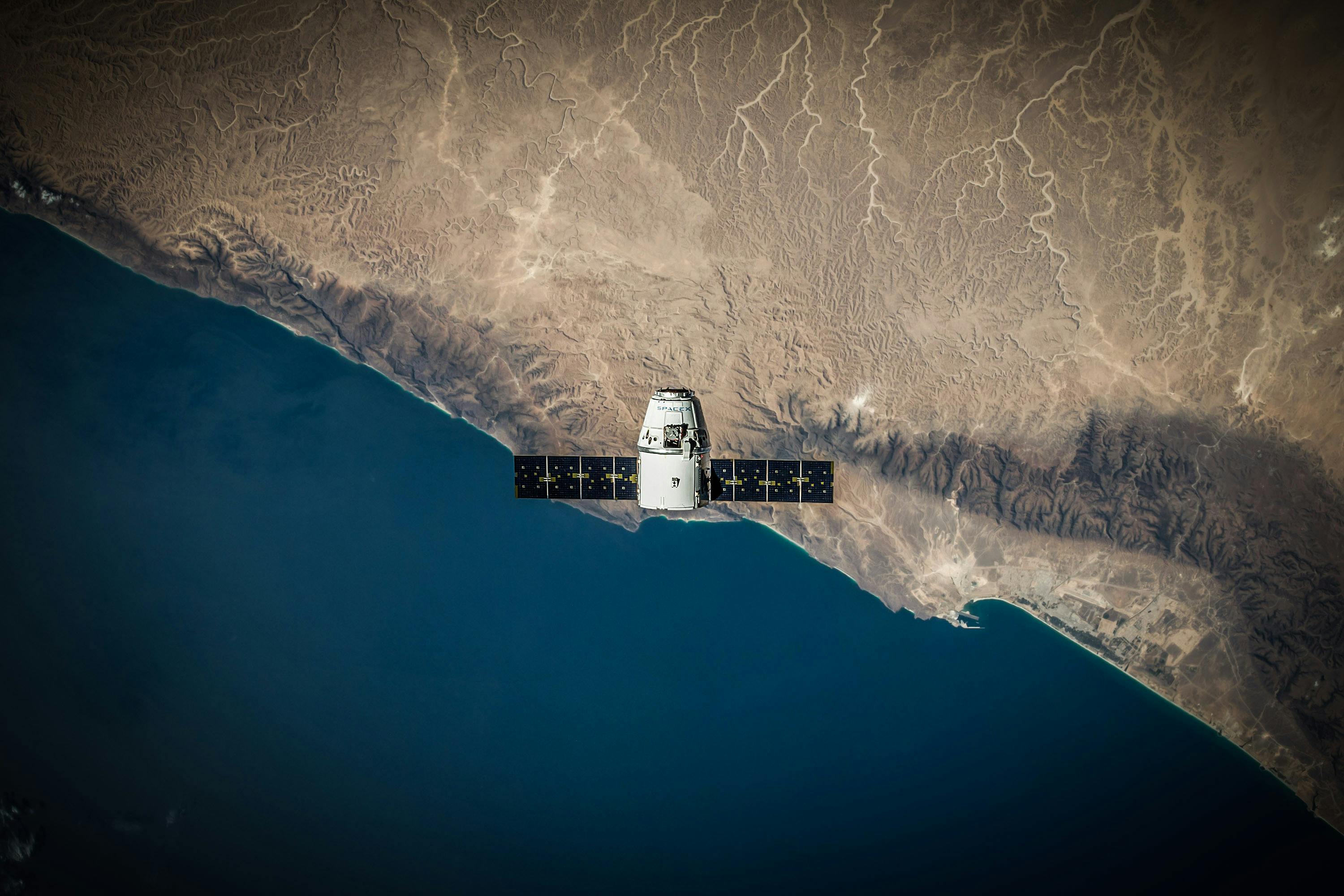
Space: SATCOM signal quality maintenance
LEO and GEO constellations operate in an increasingly congested spectrum. The Ku and Ka bands concentrate hundreds of emitters whose signatures overlap, interfere, and degrade one another. Satellite operators currently lack any embedded capability to diagnose spectral conflicts in real time. For NewSpace operators managing large constellations, this blind spot translates directly into lost capacity, degraded service, and dependency on ground-based troubleshooting cycles that take hours when the problem demands seconds.
SPECTRE embedded on the space segment provides continuous signal quality monitoring. It identifies interference, characterizes its origin, and triggers autonomous spectral deconfliction without ground intervention. The system adjusts transmission parameters to maintain signal-to-noise ratios within operational margins, even in dense electromagnetic environments. Each satellite becomes its own spectrum manager, capable of diagnosing and resolving conflicts at machine speed.
Semantic compression of downlink data is the second structural advantage. Before consuming bandwidth, the sensor decides what matters. Only operationally meaningful data is transmitted to the ground. The result is a fundamental reduction in required downlink bandwidth, more efficient utilization of the space segment, and a diagnostic capability that no longer depends on the ground control center. The satellite does not wait to be asked. It observes, classifies, and acts on its own spectral environment.
 Visual
Maritime: GPS anti-spoofing
GNSS is the backbone of global maritime navigation. It is also a target. GPS spoofing consists of broadcasting false positioning signals to divert a vessel from its course without the crew noticing. Documented incidents are multiplying across the Black Sea, the eastern Mediterranean, the Strait of Malacca, and increasingly in northern European waters. For commercial shipping operators and port authorities, position integrity is not an optional feature. It is the foundation on which safe navigation, cargo scheduling, and regulatory compliance all rest.
SPECTRE integrates with existing bridge systems and continuously monitors the integrity of received GNSS signals. It detects the hallmarks of degradation or falsification: abnormal time drift, power variations inconsistent with satellite geometry, position jumps uncorrelated with the vessel's dynamics, and signal characteristics that deviate from the expected constellation profile. The diagnosis is made in real time, with no dependency on an external connection. The system distinguishes between natural signal degradation and deliberate manipulation.
When degradation is confirmed, the system automatically switches to alternative navigation modes. Inertial navigation, radar landmark recalibration, spectral correlation positioning. The objective is continuity of navigational safety, even in a degraded or denied GNSS environment. For ports, shipowners, and maritime authorities, this capability transforms a systemic vulnerability into a managed risk. The vessel does not lose its position. It verifies it, continuously, from multiple independent sources.
 Visual
Energy: park surveillance and resilience
Offshore wind farms, distributed solar arrays, and conventional power generation facilities share a common vulnerability: dependence on a remote control center for supervision and decision-making. When the communication link drops, when the center is saturated, when the anomaly develops faster than it can be reported upstream, the asset is blind. The larger the park, the more acute this fragility becomes, because centralized architectures scale their dependencies faster than their capabilities.
SPECTRE distributes intelligence to the level of each individual asset. Each turbine, each inverter, each generation unit monitors its own state, detects anomalies in its spectral and acoustic environment, and maintains operational continuity autonomously. The embedded sensor does not merely measure. It classifies, discriminates normal from abnormal, and qualifies severity. When one asset detects a condition, it does not wait for a round trip to the control center to respond. It acts locally and reports contextually.
The collective dimension extends this capability further. Assets share their observations with their neighbors, correlate distributed anomalies across the park, and collectively reorganize production to compensate for a local failure. The end state is an energy park that monitors itself, diagnoses itself, and reorganizes itself without human intervention in the immediate decision loop. Production continuity is maintained even during partial failures, communication outages, or coordinated disruptions that would overwhelm a centralized supervisory system.
 Visual
Cybersecurity: physical layer threat detection
Conventional cybersecurity operates on software layers. Firewalls, intrusion detection systems, and SIEMs monitor network traffic. But covert RF data exfiltration channels, compromising TEMPEST emanations, and rogue wireless networks operate on the physical layer, below the perimeter these tools defend. These are threats invisible to traditional IT security infrastructure. The physical layer is the attack surface nobody watches.
SPECTRE provides continuous monitoring of a site's radiofrequency environment. It maps legitimate emissions, establishes a spectral baseline, and detects any deviation: the appearance of an unlisted emitter, the activation of an unauthorized communication channel, the signature of a compromised IoT device exfiltrating data on an unexpected frequency, the telltale patterns of a rogue access point mimicking a trusted network. Processing is local, in real time, without escalation to a remote Security Operations Center. The detection latency is measured in milliseconds, not in the hours or days that characterize log-based detection.
For sensitive sites, including data centers, government installations, R&D laboratories, and classified industrial facilities, this physical-layer surveillance fills a structural blind spot. It does not replace software-based cybersecurity. It completes it on a domain that existing tools do not address: the integrity of the site's spectral space. SPECTRE watches the layer that firewalls cannot see. Every emission is accounted for. Every anomaly is classified. Every unauthorized signal is surfaced before it can be exploited.
 Visual
Infrastructure: intrusion detection
Critical infrastructure, including SEVESO-classified industrial sites, SCADA/ICS installations, offshore platforms, and subsea cable corridors, represents high-value targets. Their perimeter security typically relies on passive sensors such as cameras and motion detectors, which are easy to circumvent and blind to threats that carry no visual signature. A determined adversary does not walk through the front gate. But every intrusion produces emissions that conventional surveillance ignores.
SPECTRE adds a detection layer based on RF and acoustic signatures. Every physical intrusion produces emissions: the intruder's radio terminal, the control signal of a reconnaissance drone, the mechanical vibrations of a sabotage attempt on a cable, the acoustic signature of an unauthorized vessel in a maritime exclusion zone. The system captures these signals, classifies them against known and evolving threat libraries, and generates a qualified alert with source characterization. Detection operates continuously, in all weather conditions, day and night, without the line-of-sight constraints that limit optical systems.
On SCADA and ICS sites, RF surveillance detects unauthorized communication equipment that could serve as an entry point for a cyber-physical attack. On offshore installations, underwater acoustic monitoring ensures surveillance of power and data cables, and detection of suspicious activity around platforms and wind farm perimeters. Embedded processing guarantees that surveillance continues to function even when the link to the onshore control center is severed. The perimeter does not depend on the network. It depends on the physics of the environment, and SPECTRE reads that physics continuously.
 Visual
Unified architecture
The five verticals described above are not five distinct products. They are five employment profiles of a single software stack. SPECTRE is a unified architecture: the same signal processing blocks, the same classification algorithms, the same embedded learning mechanisms, the same independence guarantees.
What changes from one vertical to the next is the employment profile. The monitored frequency bands, the pre-trained classification models, the alert thresholds, the response protocols. The core remains identical. This architectural commonality has a direct consequence: every technical advance achieved for one use case immediately benefits all others. A spectral deconfliction algorithm developed for satellite communications improves interference detection in cybersecurity. An acoustic classification model validated in a maritime environment transfers to terrestrial infrastructure surveillance.
This architectural unity is a founding decision of Anderion Systems. It concentrates the R&D effort on a single foundation, accelerates the maturation of each vertical, and guarantees civil operators the same level of technical robustness demanded by defense environments. Processing stays local, with no cloud dependency and no external reliance — across every deployment. This is not a product line. It is a single architecture applied to different environments.
Start a conversation
Every critical infrastructure has its own constraints. Let us take the time for a technical exchange to understand your operational environment and identify the relevant employment cases.
Get in touch